High-Performance 3D Printed Intake Manifolds
Intake manifolds were designed around what casting cores and mould pulls would allow—not what airflow actually wanted. Runner geometry, plenum shape, packaging… all compromised for manufacturability.
Stop Designing for the Mould.
For decades, intake manifolds were designed around what casting cores and mould pulls would allow—not what airflow actually wanted. Runner geometry, plenum shape, packaging… all compromised for manufacturability.
Industrial FDM changes that.
At RYSE 3D, we build induction parts that prioritise flow, packaging, weight, and iteration speed—especially where volumes are low, development is moving fast, or tooling lead-times are killing the programme.
This is engineered polymer hardware. Not “prototype theatre”.
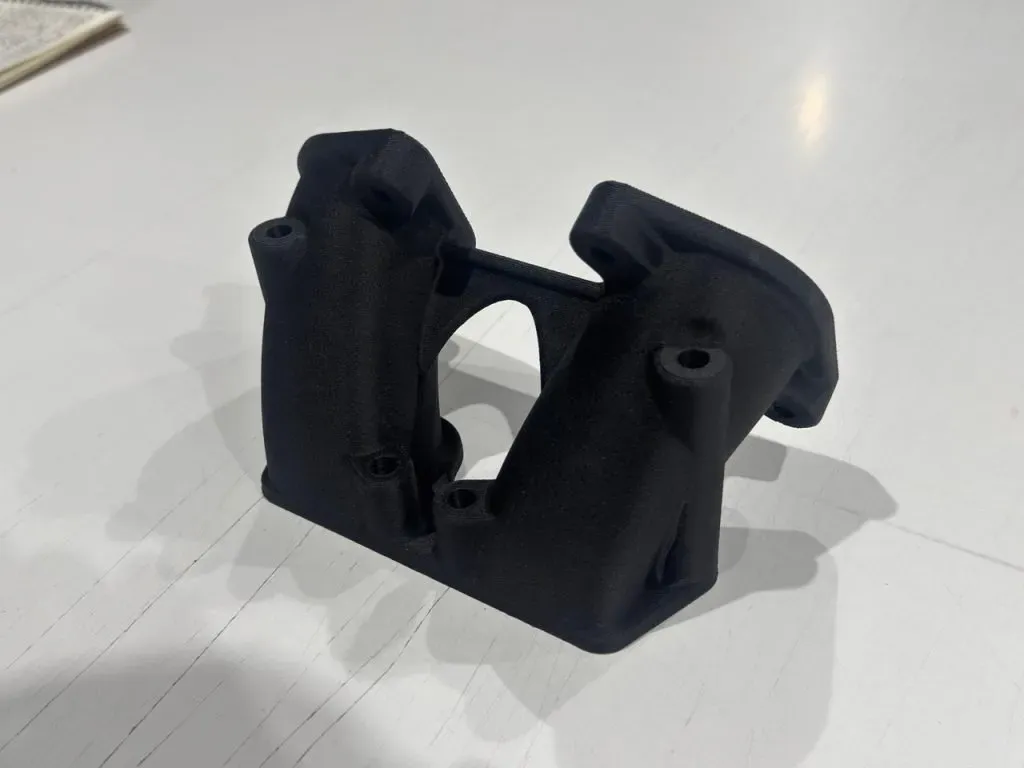

Why Print an Intake Manifold?
1) Geometry freedom where it matters
FDM lets you manufacture shapes that are painful, expensive, or unrealistic to cast in low volume:
- Tapered runners to manage velocity and distribution
- Smarter plenums designed for cylinder-to-cylinder balance
- Integrated bosses and mounting features for MAP/IAT, vacuum, brackets, etc.
- Packaging-led geometry to route around turbos, charge pipes, heat shields and ancillaries
You stop designing for tool release angles and start designing for performance.
2) CAD → dyno → repeat (without tooling pain)
Traditional manufacturing punishes iteration. Additive encourages it.
Change runner length, taper, throttle entry angle or plenum volume in CAD, print the next revision, test again—without restarting a tooling programme. That feedback loop is how you land the powerband where you actually want it.
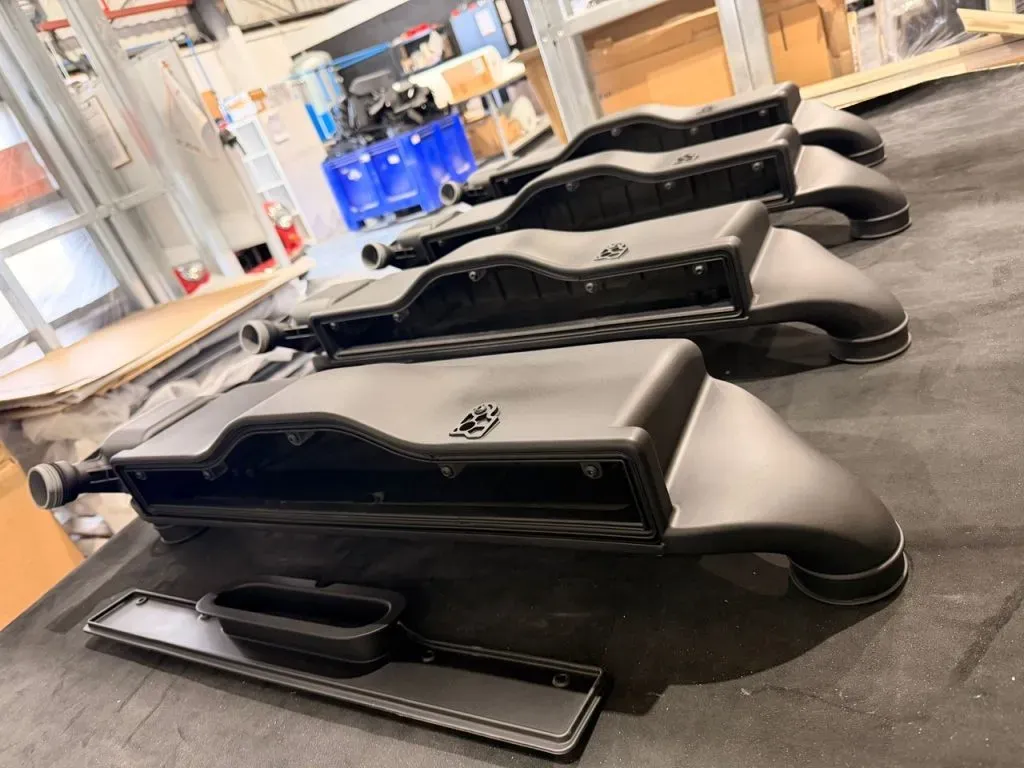
3) Large-format capability (single-piece manifolds, fewer seams)
Most “printed manifolds” fail in the real world because they’re chopped into sections, bonded together, and then asked to survive heat + vibration + boost.
We avoid that where possible.
Our build envelope is up to 500 × 500 × 900 mm, enabling:
- larger single-piece plenums
- longer runners without splitting
- fewer joints, fewer leak paths, fewer failure points
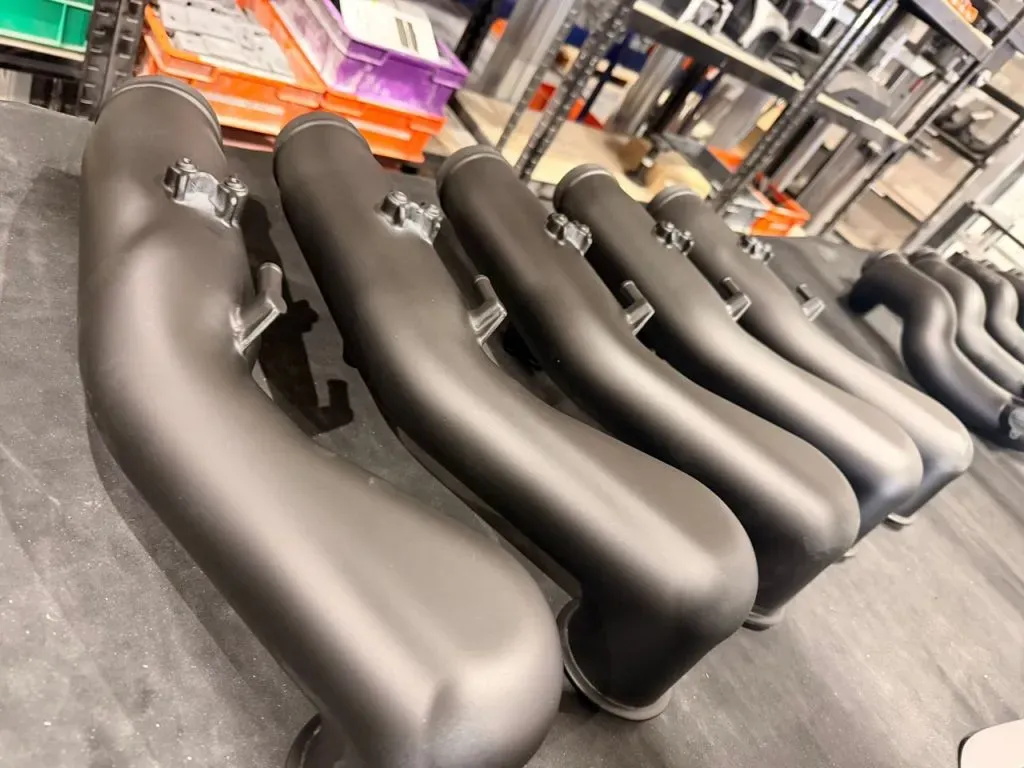
Material Selection: PA12-CF vs PA6-CF vs PPS-CF
Material selection isn’t a marketing line—it’s what decides whether the part survives.
PA12-CF (Carbon Fibre Reinforced Nylon)
A strong all-rounder for stiffness-to-weight and dimensional stability.
- Great for lightweight, repeatable builds
- Strong baseline option where the under-bonnet environment is demanding but not extreme (duty-cycle dependent)
PA6-CF
Higher mechanical performance and temperature capability than many nylon variants (application dependent).
- Suited where you need extra stiffness and performance margin
- Ideal when you’re pushing thermal/mechanical load and need a tougher engineering answer
PPS-CF
When the environment is hotter, harsher, or you want maximum stability.
- Excellent for demanding under-bonnet duty cycles where other polymers are marginal
- Premium material, premium processing, premium outcome
Important: Temperature and chemical performance depend on duty cycle (heat soak vs airflow cooling), boost/vacuum, clamp loads, and fuel/fluid exposure (ethanol blends matter). We spec the polymer to the job, not the hype.
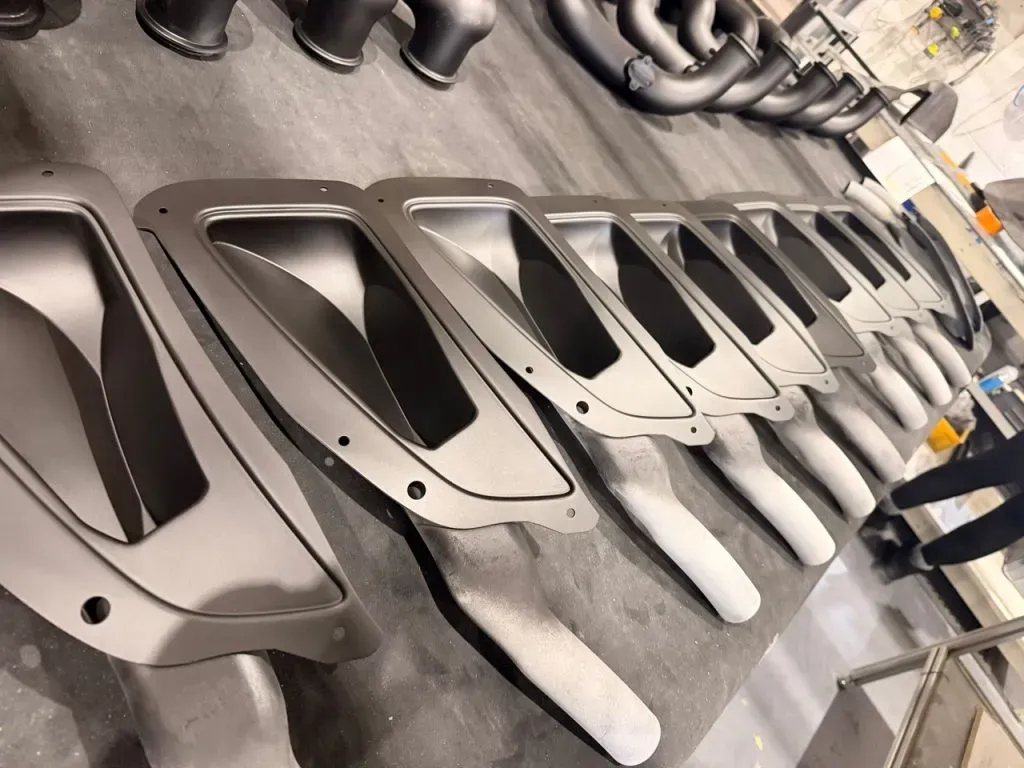
Flow Optimisation: the win is inside
FDM isn’t “mirror smooth” internally straight off the machine. The win is that you can design cleaner paths, better transitions, and better distribution—and then engineer the sealing/finish to match the requirement.
Additive enables:
controlled runner transitions and radii packaging-led plenums for distribution integrated features that reduce brackets, weld-ons and joints
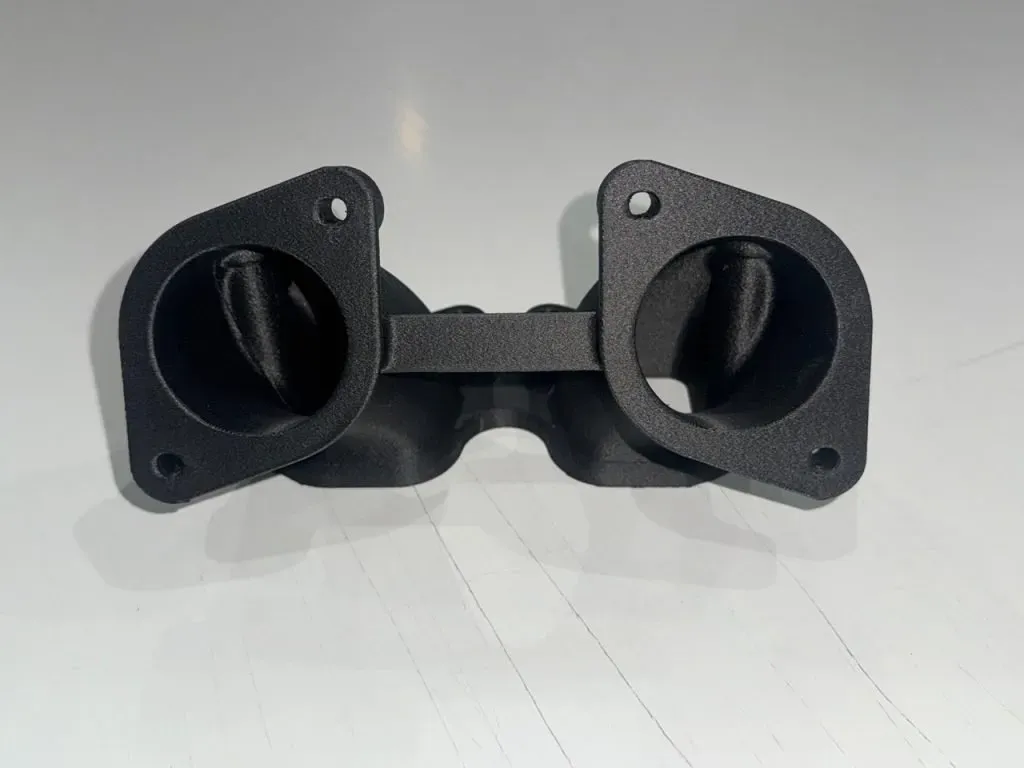
Airtight & Boost-Ready: we validate it
An intake manifold isn’t a decorative print. It’s a pressure part.
So we treat manifolds like engineered hardware:
- Sealing / infiltration where required to address micro-porosity
- Coatings selected for heat + chemical environment (application dependent)
- CNC facing for gasket-true mounting flanges
- Threaded inserts / metal hardware where clamp load and serviceability demand it
And crucially, we don’t guess—we test.
Pressure testing
For applicable builds, we can validate sealing integrity to:
- +2 bar positive pressure
- -1 bar vacuum (negative atmospheric pressure)
That’s how you separate “printed” from production-ready.
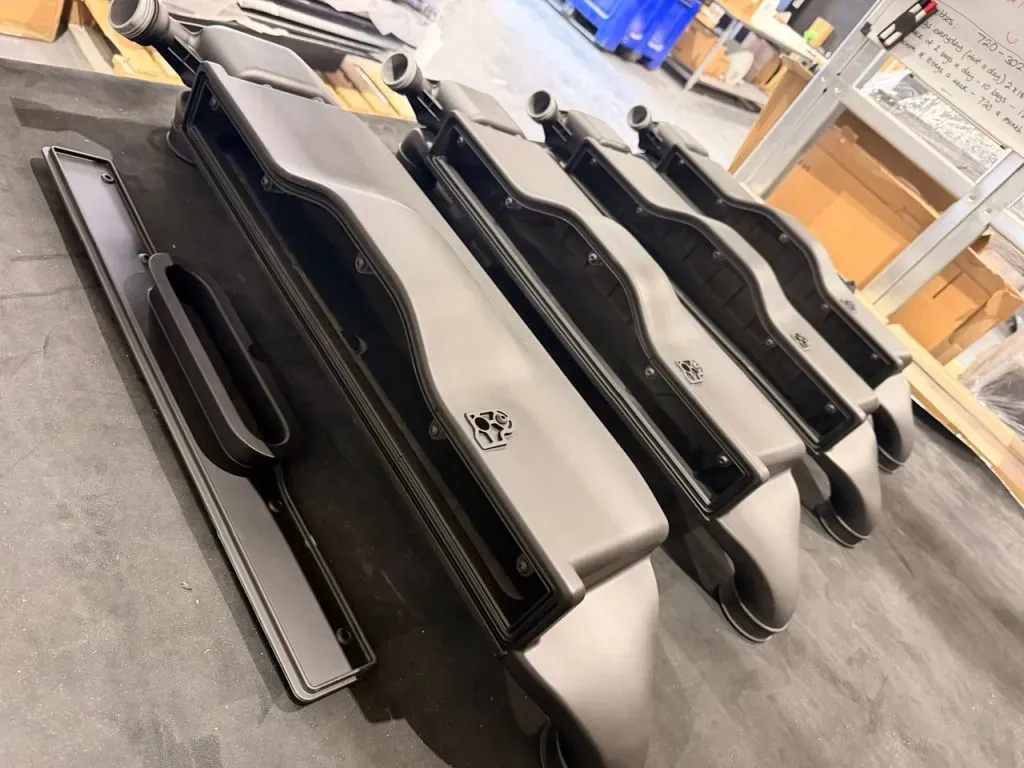
Where FDM Intake Manifolds Win
FDM is the weapon of choice for:
- Motorsport and track programmes
- Prototype / development engines
- Low-volume hypercar and specialist builds
- Restomods where tooling doesn’t make sense
- Bridge production while tooling moves or lead-times slip
If you need 50,000 units/year at minimum part cost, tooling still has its place.
If you need speed, flexibility, performance geometry and low-volume capability—additive wins hard.
Complex geometry 3D printed coolant or air hoses for high performance automotive engineering.
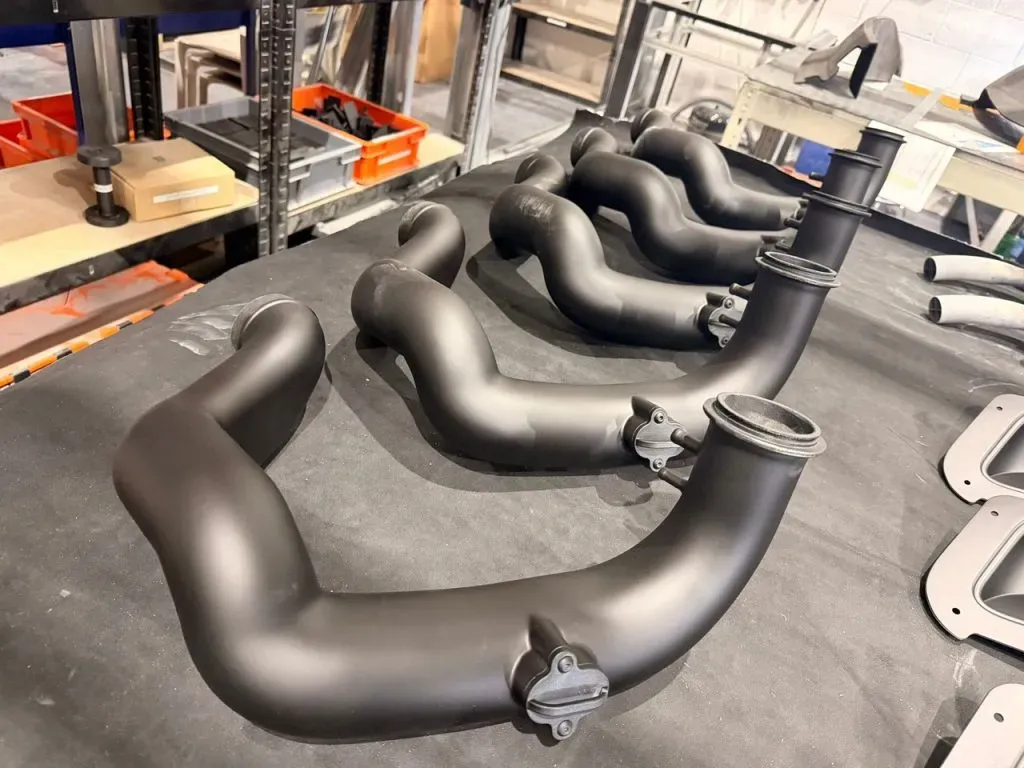
RYSE 3D: Engineering Excellence
We specialize in creating high-performance intake manifolds and fluid systems using advanced 3D printing materials like PA6-CF, PA12-CF, and PPS-CF. Our large-format capabilities allow us to produce parts up to 500 × 500 × 900 mm, ensuring a perfect fit and function for your application, whether it's for racing, performance tuning, or specialized industrial use.
Our Services
Discover the advantages of our solutions and how they can benefit your business.


Fast Free Shipping
Enjoy complimentary shipping on all orders exceeding £150.

Instant Pricing
Get real-time quotes for up to 1,000 parts, ensuring transparency.